Tuesday, January 1, 2013

Cry of Freedom

The daily Amidah includes a prayer for freedom. As part of my morning practice, in my personalized adaptation of the Amidah, I recite:  “May I be blessed, as a member of the great human family, to hear the shofar’s cry of freedom.” I penned that long enough ago that I had forgotten some of the intent with which I wrote it. I could retrace that thought process. On the other hand, today I have discovered a new path to its meaning. Rabbi Shefa Gold developed a chant derived from the Amidah text in question. She calls it: Freedom and Homecoming: A Chant for Rosh Hashana.


T’ka b’shofar gadol l’chayrutaynu
V’sa nes l'kabaytz g'luyotaynu
Sound the Great Shofar for our Freedom 
And raise the banner as we all come home.

She describes it as follows:
These  words are part of the daily Amida, but they can be chanted especially for Rosh Hashana as we gather the tribe in celebration of the New Year and all its possibilities. For me this prayer is an affirmation that while we each are sent far and wide to our freedom – to fulfill the destiny we are given – we can also return in celebration and be welcomed home.

Today, being the secular New Year and, depending on how you define it, the first day of my “retirement” from corporate life, I searched through Shefa’s archive of chants for one to focus on at this time. I picked this one. It’s perfect. As I finished chanting it I drew in a breath and searched for its meaning in this moment. From what am I being freed? To what am I coming home?

I could cynically exult in my liberation from the corporate arena, but that would actually be unfair. Say what one might about the evils of corporate life, the fact is it gave me a rich livelihood in many ways. Not only did it provide our family with material benefits, it offered me an environment within which I could learn and grow, develop meaningful relationships, express my creativity, and more. I am not being freed from a horrible institution into which I had been thrust unwillingly. It was the life I chose, for better or worse.

The answer to what I am leaving is the opposite of the answer to what I am coming home.

There is another part of my morning practice in which I ask myself what I choose to be, or do, or have this day. Today I chose to be fully Yeshaya Douglas Ballon. What did that mean to me today? It meant that the part of me that I never explicitly brought to the office—Yeshaya—is now an integral part of who I am and no longer needs to hide in the closet, so to speak. I was exclusively called “Doug Ballon” at Jones Lang LaSalle. They never even got much of a hint of my former “C. Douglas Ballon” persona. To spring Yeshaya on that them may not have been terribly problematic, but there was little incentive to do so. The question of whether I would ever be known as Yeshaya  or Yesh at work has now been resolved. In my farewell message to about one hundred colleagues I gave them my contact information using what I referred to as my full name: yeshaya.douglas.ballon@gmail.com. I didn’t make a big deal of it. I suspect most people ignored it. That was the full extent of “outing” myself at JLL. Of greater significance is that henceforth I anticipate using some form of Yeshaya everywhere, be it Yeshaya Ballon, Yeshaya Douglas Ballon, or simply Yesh. This isn’t just about a name. It’s about a presence. It’s about an awareness. It’s about an intention. It is more than an identifier. It’s my identity. It’s who I am.

This morning when I chose to fully be Yeshaya Douglas Ballon, I chose to leave behind the closeted Doug Ballon in favor of the liberated Yeshaya Douglas Ballon—one who marries his spiritual identity with his secular body of work, who places God before him always (or aspires to, at any rate). Today, this first day of a new year, this first day of a new life, I am free to be me. I am coming home to who I have always been, and to whom I have in many ways been afraid to be.

I am blessed in many ways. One way is by having the opportunity to engage in spiritual study. I have brought the gift of chant into my life with the love and support of many others. I chanted a new chant this morning: T’ka b’shofar gadol l’chayrutaynu / V’sa nes l'kabaytz g'luyotaynu, and then both literally and figuratively sounded my shofar for my freedom.  


Sunday, December 9, 2012

Solitude, Community, and Ritual

There have been other mornings such as this. Waking up before dawn. The house still, save for the clicking and whirring of various devices. Others asleep as I step purposefully through dark spaces to a place where I can light. Sometimes, as now, the cat joins me briefly. I hear her behind me crunching on kibble. Shortly she will go back to her warm spot nestled up against Debbie's body. Most significant about the kind of morning I have in mind—a morning after the night before—is an added layer of sensory stimuli—not quite a noise, or aroma, or image—none of the senses or all of them—it's a lingering sensation, maybe the inspiration for the Chanukah phrase Nes gadol haya sham—a great miracle happened there. Miracles do happen. They are seldom unnatural acts of Divine intervention. They are most commonly simple acts of human kindness. That is what my "birthday week" has been made of, that is the patina to the quiet hour before the house wakes up. That is what I would love to preserve here.

There are three components to the celebration of my sixty-fifth birthday that stand out for me. First, on the birthday itself, I had plenty of time for personal reflection, for peaceful solitude. Lately, I have been surprising myself by my growing need to be in quiet solitary space. Sure, I have meditated for decades and written journals, so that kind of space has been there to some degree for a while. What seems to be shifting is the ratio of such alone time with more interactive time. Formerly the noisy time far outweighed the quiet time. Not so much now. One might think it odd that I would so relish spending half my birthday going through old boxes and bins in the garage, sifting through ageing papers, preserving few, discarding many. Yet there I was. The first standout component of my birthday celebration was peaceful, quiet, alone time—much of it dusty!
 
The second component—and perhaps better stated, the second blessing—was the polar opposite. It was the company of others. It ranged from a hug from Debbie as I sat crunching down my morning bowl of cereal, to the sweet arrival of our children from their Eastern outposts and our extraordinary weekend together, to standing before the congregation at Sabbath services receiving their energy and wishes through song, to the amazing din of chatter and laughter that filled this house last night as mostly extended family and a few friends gathered not so much for my birthday, but to light the first Chanukah candle. That din accounts for the lion’s share of the morning-after-the-night-before echoes in my mind. At one time we thought this gathering might incorporate some element of birthday celebration, but rightly we separated and simplified the events and let explicit references to my sixty-five (and Jacob's recent thirty-five, 65+35=100!) end at shul in the morning.
 
The third—I'll say it, blessing—was ritual. We have many. We waited for the seven of us to gather before singing "Happy Birthday."  That came after an "extra supremely joyous" (as Jacob would say in his youth) Shabbat dinner. At shul the next morning, a morning on which the Torah reading was identical to the one I read at my Bar Mitzvah in 1960 and Jacob read at his Bar Mitzvah in 1990, he and I ascended the bimah, took part in leading the blessings over the Torah, and then each received a personal, "custom" blessing from the rabbi. This is a ritual he performs so well. I have experienced it before and each time I revel in the depth of the blessing he bestows, how profoundly apt his choice of words are, his sincere appreciation of the recipient of the blessing and what specific aspects of their lives would most be in need of blessing. As in times past I stood transfixed by his energy, by the spiritual exchange, trying to hold onto his words even as they continued to flow over me, and ultimately knowing that this was a singular moment in time, never to be captured and fully preserved or relived—just savored. I know he made an important reference to my age-ing and sage-ing that I drunk in with thirst and appreciation.

Solitude, community, and ritual—these would be the big three, my formula for a blessed, joyous, landing into this new era. There were other manifestations of each of these components woven throughout the days of celebration. There was a quiet dinner for two with Debbie on my birthday itself. There was a more raucous lunch at our favorite Mexican restaurant, Friday, after the arrival of the "kids." Suddenly, as I write this, I realize I should surrender to the fact that a fourth component—both curse and blessing—is food. Oh, how I have struggled to integrate the common practice of celebrating with food with my stumbling attempt to develop more healthful eating habits! I am definitely not there yet as the scale attested to this morning. More about that another time. Suffice it to say there is much work to be done, not only in losing some rebound pounds I’ve gained, but in the bigger picture, truly finding a safe path through the eternal land mines of personal and community celebrations.


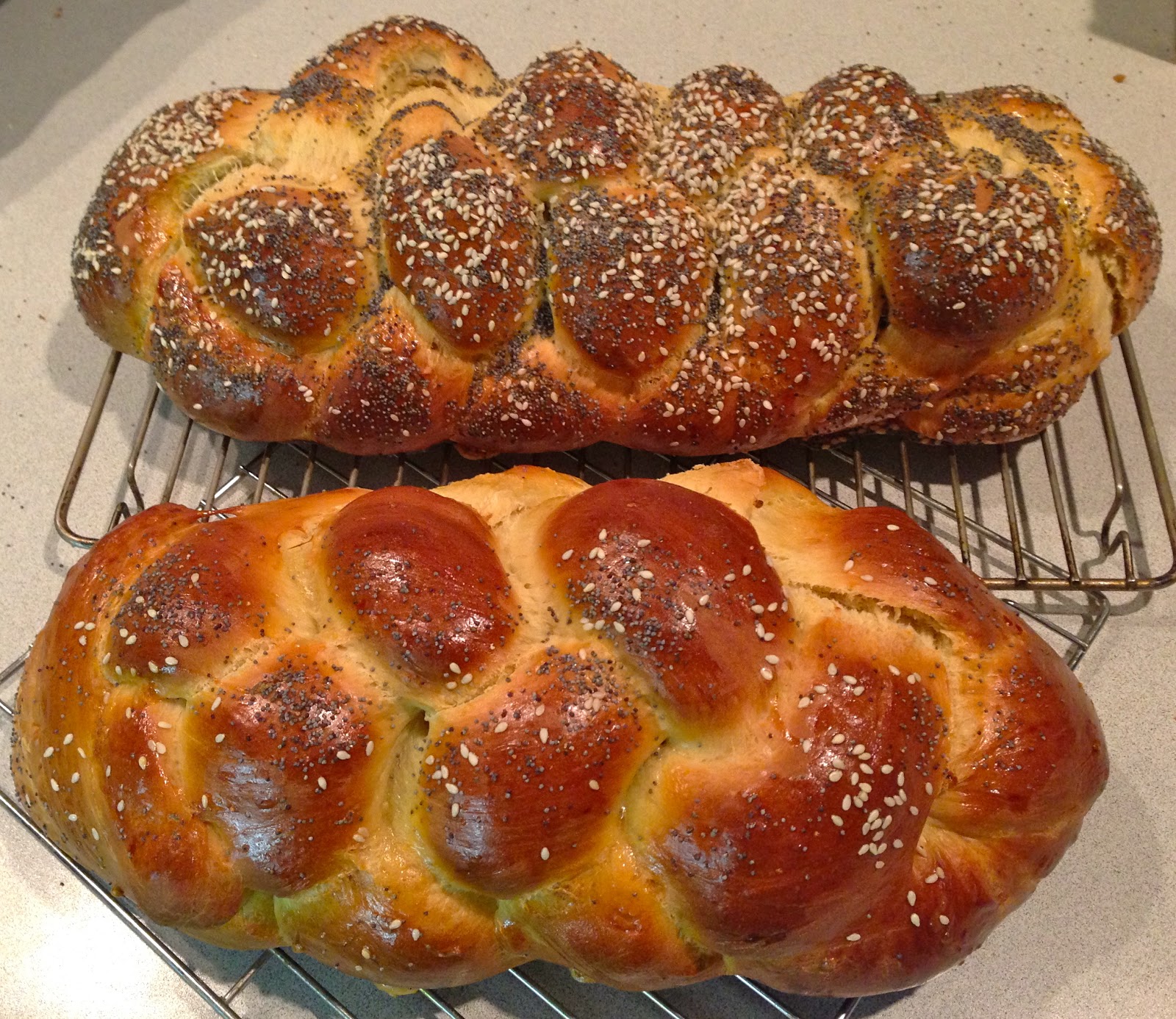
Back to my reflections of these past days.... One activity that contributed both to the joy as well as my delinquency was making challah with Shira on Friday. Side by side we braided two loaves that each turned out uniquely beautiful and were blessed and consumed with gusto by all. As planned we also invited the kids to participate in our beauty and order campaign in the garage. We gave them the opportunity (requirement) to do as I had done on my birthday—to sift through their stored belongings in the garage, to dispose of those things that no longer were important to them, to take with them or ship to their respective homes what they wanted to have there, and finally to leave us with far fewer things stored on our premises for the time being.


Before dinner we conducted what may become one of our most memorable and important "family meetings." It had been many years since we had convened one of these. It used to be a somewhat regular event back in the day, replete with agenda, minutes, story reading, and refreshments. This was our first as a family of seven. The topic was the estate planning that Debbie and I developed last summer with an emphasis less on the legal aspects of it and more about some of our softer, unbinding requests concerning how we would like to be cared for at a time when we may not be able to explicitly voice these concerns. Jacob, who would have certain defined responsibilities after Debbie and I die was wise to voice what he saw as an important reason for this conversation—the need to create transparency, allowing all to know the terms and conditions well ahead of the need to engage them.

This was followed by a Shabbat dinner that looked much like the Thanksgiving we didn't have together in November, including turkey and most, if not all, of the traditional accompaniments. Pumpkin and pecan pie were replaced with a birthday cake inscribed “Happy 65+35=100!”

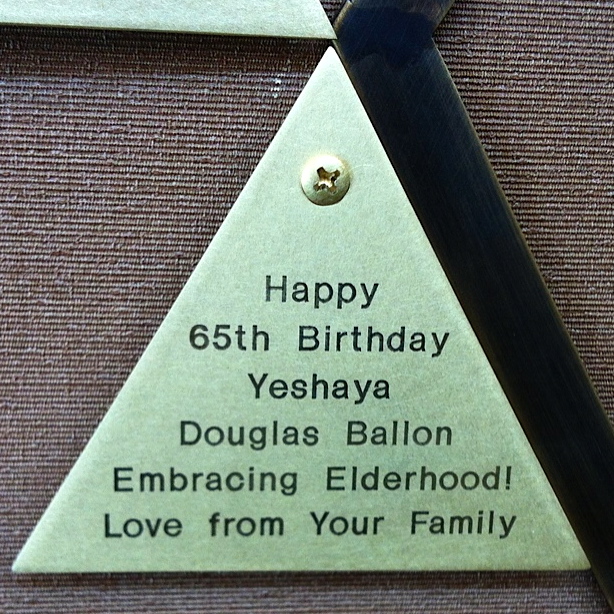
Saturday was huge. After Jake and I received the blessings from the rabbi I delivered some remarks at the rabbi’s invitation (viz., http://yesh-indeed.blogspot.com/2012/12/there-is.html). There was far more I could have said than I chose to say. I kept it well under five hundred words, and focused on appreciating the present moment, concluding with the Shehechiyanu prayer. A particularly sweet moment came later. With the recent renovation of the synagogue lobby one wall is now adorned with an array of different colored metal triangles each awaiting an inscription to mark a special event in the lives of congregants. The very first triangle to receive such words is pictured below: 

This was a sweet surprise that the family revealed to me during the Kiddush lunch after the morning service.
 
Later we spent most of the remainder of the afternoon preparing for our Chanukah party. The party itself was loud and fun. Jacob and Alana led us in havdalah, we lit candles, ate like horses, laughed over a gift exchange and talked into the night. Which brings me to this moment. The sun has risen. I hear the voices of others as the house awakens, and I much rather be with them than sit here tapping these keys. TTYL.

There Is!

The rabbi invited me to receive a blessing at the Shabbat service near my sixty-fifth birthday, and to make a few remarks about what it meant to me. It was also the same Shabbat, Vayeshev, upon which I celebrated my bar mitzvah in 1960 and upon which Jacob celebrated his bar mitzvah in 1990. Between the two of us we are now 100 years old! Consequently Jacob joined me on the bimah to recite the blessings over the Torah and to receive blessings from the rabbi. My remarks are below.


Congregation Beth Jacob
Redwood City, California
December 8, 2012
Shabbat Vayeshev

Some of you were here five years ago on the occasion of my sixtieth birthday when I first asked you to call me by my Hebrew name, Yeshaya. A short time after that, at the suggestion of the young lady who is now my daughter-in-law, I adopted the nickname Yesh, for short. The decision to be called Yeshaya or Yesh in many ways came out of having an adult bar mitzvah earlier that year that launched me on a new leg of my spiritual journey.


Right now I am taking courses in chanting, Talmud, spiritual aging, and Biblical Hebrew. This week in Hebrew class, as we reviewed our new vocabulary words, on the list was the word yesh! Yeshaya, my full name, is Hebrew for Isaiah—which means God is my Salvation. Yesh is a very different word in Hebrew. It is the simple declaration—there is!


What I found fascinating in class was when our teacher told us that unlike most other verbs, “Yesh is always in the present tense.” I thought about that and felt what a challenge it is to live up to my name—for me to always be in the present tense.


At milestone birthdays, such as sixty-five, it would be easy to look back with regret or condemnation at some of the things I have done or not done, or at the terrible things that I may feel have happened to me. It is also tempting to become fearful or anxious about what lies ahead that might be painful or disappointing. The challenge is to always be present. In this specific moment I have only to appreciate that I am healthy, living in peace, standing among an extraordinary community in a magnificent synagogue, and most of all blessed with a loving family—this is true abundance for which I am very grateful.


This is what we call a Shehecheyanu moment. Approaching this birthday I looked at the Shehecheyanu prayer and wondered about the fact that it’s only recited with first person plural words—thanking God for giving us life, for sustaining us, and for enabling us to reach this moment. I couldn’t find an explanation of this. While a person may speak the Shehecheyanu alone, the fact that it’s written as a plural brings awareness that when it comes to our birth and our sustenance, none of us can do it alone, nor I suspect would want to. So it’s with full appreciation of all of you that I ask you to join me in this prayer.


Baruch atta Adonai Eloheinu melekh ha'olam she-hecheyanu ve'qi'eh'manu va'higiy'anu laz'man hazeh.

Thursday, December 6, 2012

Finding Genius

DISCLAIMER: My apologies to the reader. I really don't have the motivation to refine this piece into any semblance of good writing— even at the level of my own low standards. So read this at your own risk! I am posting this with the sole intention of keeping these thoughts alive for my own future reference.*

 ======================================
  
We attended Michael Moore’s seminar Finding Genius in Your Life. It actually clarified a few things for me. Michael quoted Robert Bly at the end and encouraged us to write down our insights right away because we all have an inner Nixon that will erase the key parts of the tape. Ha!

Here is what I can access for now. More may come if and when I listen to the recording of the session.

One flash came when a woman I know a bit walked over at the break and essentially declared in so many words that my genius was to be a rabbi. Part of me would like to have denied it just as it has denied me the actual title of rabbi. A far deeper part of me was deeply moved just to hear her words. A part of me acknowledges and embraces the truth that I love Judaism, that I live it to some degree, that I continually study pieces of it that I find meaningful, and that as a rabbi in the broader sense—as a teacher—I lead others to live and love some of what I live and love in Judaism. Her words resonated within my gut. They began to bring tears to my eyes. In the context of the seminar she confirmed my genius—that piece of my spirit and my soul that is my gift to myself and others.

Later, in a one-on-one conversation with a fellow participant named Jim I reflected on that part of me that sang my song early in life—my art. Art is a fundamental piece of who I am. It has been speaking to me with a more insistent voice lately wondering when I will reclaim it or vice versa, when it will reclaim me.

Once I was asked by a “New Ager” at the Esalen Institute to describe myself in three words. I responded, “Artist, Teacher, Lover.”  I think I would amend that to describe my genius—Artist, Teacher, Jew. I must add quickly that that is very different than “Jewish Art Teacher!” Combining them that way makes each much smaller. I see the possibility of expanding each into its fullness—to experience the fullness of myself as an artist, the fullness of myself as a teacher, the fullness of myself as a Jew—and to bring these all together in different settings in varying proportions to reveal my fullness to myself and the world.

In my one-on-one with Jim I realized first of all that Michael’s premise for the exercise was a simple and powerful pedagogical tool. He saw that in a room of one hundred people not everyone was going to be able to voice his or her truth to him. (My hand was up all day and I was never called upon.) He also stated that there is a powerful difference between thinking about the issues that were coming up and speaking them. He was right. By voicing my observations to this complete stranger the words were given power (as they are, for me, by writing them now).

As I continued with Jim I observed that I had much more clarity about my genius than I might have been able to recognize before the seminar. Not only do I truly know that it resides in the arena bounded by art and Judaism and teaching, I can also take comfort in knowing that I have integrated all three of these into my life already and that I have engaged in important activities with them to continue along a path of growth in these areas (perhaps less so the art, but that is coming back with increasing awareness of late). 

Michael talked about the need to balance fundamental considerations of making a living with the spiritual/soul sphere. I think of the model of the shtetl craftsmen who plied their trades all day in order to go home and study Torah. I was also reminded in a dream last night of how my first job was a summer of commuting to NYC to pack crates with truck parts to send around the world. I used the proceeds of the entire summer to buy my $350 wardrobe to attend college in the Fall. That image alone could provide a personal model, a coping mechanism for continuing a few more years of work, as I save money not for a new wardrobe but for retirement. Moreover, there is a real possibility of feeding my soul at work as it had been fed up until the last year. I am hoping my new boss follows through with the idea of providing a better match between my skills, talents, and experience and the job responsibilities I have in 2013 (namely to develop and deliver training, rather than be limited to a few bureaucratic oversight functions as I was in 2012).

So I know what I need to do. I am on a path that integrates much of it into my life as it is now, and is positioning me to have an even fuller involvement in my “genius” as I head to my next career (Call it retirement if you want, I’m not sure that that is the correct terminology). One could easily argue that it is folly to defer full involvement in one’s genius until one has developed financial independence. On the other hand it seems very appropriate, now that I am on the precipice of such independence to complete creating that platform to have the freedom that “retirement” will allow, to do what I want when I want for the rest of my life. If I were doing nothing to advance my “Artist, Teacher, Jew”  capabilities, then I would be more concerned. But the fact is I am doing stuff now—leading services, chanting and meditations, writing, etc. I am preparing for greater leadership—DLTI, Kol Zimra, Hebrew 101, Spiritual Eldership—so that I will be poised to pull all of this together in an amalgam of art, music, prayer, journaling, spiritual eldership, teaching, facilitating. However many days I have left there will be much to be and do and have. I have all the tools and I am adding to them.

As we drove home I mentioned to Debbie that I was feeling—somewhat antithetical to what I perceive my basic nature to be—that more order in my day-to-day existence may be of great value. I would do well to heed the lessons I learned and taught as a Covey instructor—weekly planning, integrating aspects of my key life goals into every week, including daily “saw sharpening” of meditation, exercise. I would add to that weekly food planning—developing a clear set of repetitive meals that provide a foundation for nutrition and satiety and still allow enough variety to be stimulating and emotionally satisfying. Moreover, my dream this morning instructed me to avoid the backslide that would come from abandoning the elements of success that helped me lose 60 pounds this year. Lately there have been far too many “exceptions” and far too few normal days of maintaining a healthy focus on food planning, selection, portion control, and journaling. 

My birthday is Tuesday. Rather than using that as another excuse to binge, followed by the kids visit as another excuse to binge, followed by Chanukah, and Christmas and New Years and Tu b’shevat, and every other excuse in the world. Let me make Tuesday a model of the year to come. Let it build on my four months of strict control and the two so-so months that followed by being twelve months of consciousness, of weekly planning and attending meetings that reinforce daily weighing in and journaling that document hour by hour exercise of conscious eating. Is that over the top or is that the only way?

As I post this — two days after my birthday — I am aware that I was partially successful in my intentions for that momentous day. I did eat rather moderately. I did not achieve all my goals, and I am willing to forgive myself for those small indiscretions. Baby steps. As Michael Moore said about finding one's genius — if it were easy he could just throw a PowerPoint up on a screen and we'd have it. 

======================================

* I can hear the boo birds chirping, "What makes you think any of the rest of your swill is any better?"

Tuesday, November 20, 2012

The Puberty of Old Age

When I turned fifty, the elders in my family told me not to get too upset about it. “Fifty is the youth of old age, “ they said, as if that was somehow going to make me feel better. They were in their eighties, or thereabouts, and could easily see fifty as young, and with equanimity acknowledge that it was edging up on “old age.” These days, even that part of the declaration might be challenged, but from my perspective at the time, I did seem to be getting a bit long in the tooth.

In two weeks, God willing, I shall turn sixty-five. If fifty is the youth of old age, I wonder what sixty-five could be. Fifteen years later—I must be ensconced in puberty! What else could it be? Instantly, all the ways that that seems true flood into my head. This is not like sixty, that for me at least, arrived with a wave of promise (I demurred at saying “Sixty is the new forty,” and was the first I knew of to declare it “the new sixty.”) For some reason I did not tiptoe into it. I grabbed sixty with relish. I had just finished the text of my ethical will. I rented a cottage in the countryside, gathered my family, and the five us had a sweet day of sharing deep thoughts, fine food, and the warmth of a fire. The seven of us now will gather and replicate some of that, but sixty-five approaches with a different sensibility.

How is sixty-five like the puberty of old age? For starters, whether I can attribute it to this milestone or not, it is coming at a time of relative angst. 

Take work, for example. Unlike sixty, which may have caught me smack dab in the middle of my most productive and rewarding time in my profession, sixty-five seems to be arriving at an interlude of change, exploration, and uncertainty. Like a teen, I am struggling to identify who I am, where I am going, whether anything I am doing is deemed worthy by my peers, if indeed I can even identify my peers. The job has definitely diminished in every respect. I no longer feel certain about my contribution and I am certain others share that sentiment.

As for my marriage, which I hasten to insert has weathered more challenging times in the last forty-two years, it is also a period of introspection. Both of us are confronting challenging issues that put a tinge of confusion into many of our relationships including this most fundamental one. This was the year that we, at long last, finally dealt in a mature manner with certain long-term personal planning issues. We finally abandoned a much out-of-date will in favor of a complete estate-planning package. While this provided a sense of accomplishment and relief, it did not do so without the price of forcing us to seriously confront our mortality. This may have had some bearing on our looking at several retirement living venues where our “puberty of old age” status was reinforced. Engaging with others fifteen or twenty years our senior had a dual effect of making us feel relatively young while simultaneously introducing us tangibly to the proximity of “the old age of old age.” 

As Debbie and I have been grappling with these issues we have been forced to speculate about a number of retirement related questions such as: when will we retire? What will that be like? What will we do as individuals and as a couple? Are our current mutual interests enough to sustain us as our respective individual interests seem to have diverged over the years? There are more questions that linger both consciously and unconsciously that can, on occasion, interfere with marital harmony, but I sense will ultimately make us stronger.

As a consequence of these first two issues I have had to engage in substantive conversations with my financial advisor about the feasibility of ever retiring. Up until the summer of 2011, when the company started to jerk me around in my job, I was blissfully under the impression that I would do this work as long as I cared to—easily until age seventy. Now I’m not so sure, and I need to be prepared to exit on my own terms at the optimum moment—whatever that turns out to be. To do that requires even more contemplation of the unknowable. What will I do? When will I do it? How will I live? Will I be able to afford it, etc.? This is an exercise that can bring enthusiasm and gleeful anticipation or fear and dread—more likely both.

Of course, the number one issue of puberty for many of us was body image, and while I have fallen head over heels in love with my “new” body (If you haven’t been paying attention, I intentionally lost somewhere between fifty to sixty pounds this year.) it does present me with a continuing set of challenges. Along with many others I wonder, “Who is this guy? Will he keep it off? Is he healthy or dying in front of our eyes? Is he as much fun as when he approached food and life with reckless abandon? Does this sweater go with that shirt?" And so on.

I’ve always had a sense that a good memory in some respects can be a handicap—especially when it comes to carrying around the angst from past years. I know that at every age we deal with the unique issues of that phase of life, and that the problems of that time may seem massive, serious, and inescapable. Yet, as time passes and we go on to the next set of massive, serious, and inescapable problems, we look back at how we may have overreacted to what in retrospect seems so trivial. Like a huge throbbing zit on the nose of life, one problem after the next gets thrown in our faces. We stare in the mirror and wonder “Why me? Why now?” Yet, somehow we move past each one. Occasionally we move into periods of relative clear sailing, beset perhaps with some daily stressors, but less so with the continental shifts of physical or emotional change. There are those times, if we are so lucky to notice them, when we can say, “Life is good!” I have a friend who says that “happiness is a temporary state of illusion.” I think he means that there is no good or bad. It’s more of how we label what life hands us and how we respond to it. Sometimes I feel more capable of pulling out the “happy” label than others. I won’t know how that will manifest when I reach this coming milestone until I reach it, and even then it likely will be an ephemeral state.

When I was a kid, puberty seemed like it would never arrive and when it finally did it wasn’t such a welcome guest. At least sixty-five is on a clear and certain timetable. I don’t have to guess about when it will occur. (If it will occur is an issue that no one should take for granted.) Let me therefore pray that I have the strength and courage to meet it at the door with at least some of the enthusiasm with which I greeted sixty. I hadn’t anticipated sixty-five would be such a big deal, but when you get that Medicare card it brings a dose of reality that is undeniable. The last time I remember getting such a buzz over a little piece of cardstock was the arrival of my draft card forty-seven years ago. Maybe it's time to go back out on the streets and shout, "Hell no, we won't go!"

Monday, October 29, 2012

Ho, Ho, Ho!

Is it true that fat people are jolly? No, I’m not buying that stereotype. How about the reverse? Are jolly people necessarily fat? There may be some truth to that. Have you ever heard anyone apply the adjective “jolly” to a skinny person? Can you even picture a jolly skinny person? I’m gonna have to go with the idea that jolly is a term specifically reserved for the corpulent. Consider, for a moment, the loss to humankind if  “Old Saint Nicolas,” for one, achieved a normal body mass index. It would be devastating to children around the world, to the elves and reindeer, not to mention Mrs. Claus.

This issue of jolliness reminds me of the old joke—Q: How many Feminists does it take to change a light bulb? A: That's not funny!!! There seems, increasingly, to be an aspect to the new improved (physically that is) Yesh that is simply not funny, or more succinctly, not fun. This was something I had feared from the beginning—that is, what part of my very essence is attached to the reckless abandon and joy of immersing myself in the gustatory delights of the universe? How would a campaign of discipline and relative deprivation affect what had been an emotional as well as a physical feast at life’s table?

Feedback from people close to me suggests that someone not only has kidnapped the body of the old Yeshaya Douglas Ballon (by any name), but the spirit as well. This is a serious issue. I look at my last two blogs and I see a vexing trend. Is this disagreeable emergence in my affect a result of six months of relative food deprivation or is this a coincidence? Are there other factors at work (e.g., changes at my job, contemplation of retirement, an overfull to-do list, irregular patterns of exercise, writing, meditation, etc.) that are the primary causes? Or is this just a “perfect storm?” Can I even sort out cause and effect or am I in a vicious cycle spiraling out of control?

There are many challenges associated with achieving my goal of normal weight. In attaining any goal, there are always trade offs, some of which sneak up on us. I must note quickly that this transformation I am undergoing is by no means over. It has only just begun. The physical loss of fifty or sixty pounds was front loaded by virtue of a highly restrictive four-month diet. The maintenance part of the weight loss program is designed to be a long-term venture. Included in that, unquestionably, is a huge emotional component. For me that’s not only a question of returning to a life of eating real food in a healthy, life-sustaining way, but also finding a comfortable presence and a palatable demeanor in our food-centered social world. Another way to put it is—can a normal body and normal behavior coexist for me?

I was delighted this summer to connect my physical quest to a spiritual quest by selecting “lightness” as my focus. To that I must add an emotional aspect—to be lighthearted, to light up a room rather than cast a shadow, to rekindle what a friend suggested was a spark that I have seemingly lost. This seems much more challenging than losing the fat. No one said losing weight would be easy. On the other hand, I couldn't have anticipated the exact nature of these intangible unintended consequences either. As in any transformation, awareness is the first hurdle, and as I gain insight I can set new goals. As long as I maintain my new trim figure I may never be labeled “jolly” again. That I can live with. There’s an alternative that I strive for. Just as I’ve trimmed a few pounds from my middle, maybe I could judiciously trim a just few letters from the middle of “jolly” and at least be left with “joy!”


Tuesday, October 16, 2012

Rings of a Tree


“Why is it important to know when one can say the Shema? Why isn’t it good enough to just say it?—and why not at any time you want?” Debbie asked the perfect questions when I told her with excitement about the first words of the Talmud that our study circle had gnawed on earlier in the day. I had left that session with such an extraordinary sense of connection and enrichment. The question I was asking myself was whether there was any way to convey to others the immense power of studying Talmud—how enriching, enlivening, how relevant it is to every moment, and to developing the kind of consciousness so many people I know strive for. These are huge questions that I can only imagine rabbis have been tackling for millennia. Now it’s my turn.
 
To set some context, let’s start with a beautiful lesson that I received courtesy of Rabbi Peretz Wolf-Prusan via a recording of a recent virtual Talmud study session (Gotta love that technology when it serves to communicate something of real value!) Like John Madden using a football telestrator, Peretz traced on the screen for us the literal and figurative concentric circles that start with a snippet of Mishnah. Growing outward from that is a section of Gemara. Medieval commentaries ring around the Gemara. Words of later commentators ring around the Medieval commentaries, and finally, sitting around the table studying all of this are members of the Bay Area Community Talmud Circle —like rings of a tree.
As long as these rings are growing the tree is alive. The moment that there are no more rings—that usually means the tree is dead.
Torah forever grows, and depends on ever-expanding circles of study. I may not be Rabbi Gamliel, but, by opening these pages I am continuing his work with Jews all over the world of all times. This doesn’t directly respond to Debbie’s question, but in one sense it is the answer. It may or may not be important to know when to say Shema, but it is important to carry on the conversation about it that was started so long ago. (Nonetheless, as I hope to demonstrate, it actually is important to know when to say the Shema.) So this is important work—this act of study— almost regardless of what we actually discover or conclude about the content per se.

Our morning of study was like a piece of poetry, very densely packed with experience beyond its apparent size. (I almost used a “zip file” analogy, but that can be rationally unpacked, so fails to convey the true immensity of the experience.) Under the deft tutelage of Rabbi Lavey Derby we made connections that defy description—to text, to philosophy, to spirit, to ancestors, to people in the room, and to people not in the room. It's the flip side of the famous When Harry Met Sally scene—I really wish others were having what we were having! So here is just a glimpse….

The introduction to Perek I (Chapter I) states that the rabbis were looking at a different question than Debbie was, but one that is at the heart of hers—“What are the practical implications of the text of Shema? Particularly, how is one to understand the terms, ‘When you lie down, and when you arise….’” Let’s look at that.

To talk meaningfully about this requires awareness that there is a unique version of the Shema that one recites as “you lie down.” Who knew? I used to say Shema with the kids as we tucked them into bed just as my dad did with me, but it was just Shema. I didn’t know about the paragraphs that the liturgy provides before and after the Bedtime Shema. Learning this fact alone is immense, not as information in and of itself, but because these paragraphs are so beautiful and powerful in their practical benefit to one’s life. 

The practice includes ideas that I have heard talked about, but had not realized were so elegantly woven together in a succinct bedtime ritual. It starts with forgiveness—for those who may have wronged us. Then it addresses seeking personal forgiveness for our own sins. It petitions for peaceful sleep and the miracle of awakening in the morning. Only after these acts of granting and seeking forgiveness, after prayers that demonstrate appreciation for the gifts of rest and of continued life itself—only then do we utter the Shema acknowledging the unity of all that is. 

These words are followed by the familiar paragraphs from Deuteronomy commanding our love of God and our obligation to keep God before us through various acts including teaching our children and reciting Shema when “you lie down, and arise.” This is followed by psalms and the lovely Hashkiveynu prayer seeking God’s protective canopy of peace through the night. The archangels—Michael, Gabriel, Uriel, and Raphael—are invoked for added protection. It concludes with a passage familiar to most synagogue service attendees—the Adon Olam—which until recently I only associated with the grateful awareness that a long Shabbat service was ending and a tasty Kiddush was about to commence. Sadly, that does this prayer such terrible injustice. It was a revelation to learn recently (on the first morning of Shefa Gold’s Kol Zimra workshop) the magnificence of chanting just two lines from Adon Olam and bringing full consciousness to them: “Into His hand I shall entrust my spirit when I go to sleep—and I shall awaken! ...God is with me, I shall not fear!”

Learning the significance of the Bedtime Shema helped make more sense out of the conversation of the rabbis. When they ponder whether you can just say it at the beginning of the evening, as rabbi Eliezer states, or until midnight as the Sages suggest, or until dawn as Rabbi Gamliel responds—this makes a difference. If nothing else, it demonstrates that there have been, and will always be, different points of view—all with some validity—that must be considered. Rabbi Eliezer is wise to create a sense of urgency and timeliness by insisting that we perform the ritual right away. The Sages are right in allowing some flexibility. Rabbi Gamliel is right in tying the time, as he goes on to explain, to the hours available for the priests of old to perform a particular holy sacrifice in the Temple. This helps make the point that in a post-Temple world our acts of prayer replace the ancient sacrificial rituals, and that we are still connected to their power and sanctity.

The practical application of this in my life is being able to open my eyes in the pre-dawn darkness and start my day with God awareness that I seek to carry with me throughout the day. How good it is to appreciate awakening itself as a miracle, to start my day in gratitude, to realize that I can still say the Bedtime Shema and grant and seek forgiveness. I am only scratching the surface of what a morning of seemingly irrelevant Talmud study can do. Consciousness like this, applied throughout the day, can only help one to choose words and deeds more wisely to help sustain oneself and one’s relationships with others. Why is it important to know when one can say the Shema?—in more ways than one can ever know!