Monday, February 11, 2013

Ner Tamid


There is many a rationalization that betrays the mind—and body for that matter. One that I’ve been particularly fond of is the idea of the “double portion” on Shabbat. Regardless of how well or how poorly I have been maintaining consciousness and appropriate eating behavior during the week, I have allowed myself free rein to eat anything and everything on Shabbat. After all, it is said that we got a “double portion” on Shabbat when wandering in the desert for forty years—or something like that.  Perhaps it would be useful to examine this idea, to understand just what the Torah says about it before I make it a permanent theological underpinning to my weight management (or mismanagement) regimen.

The reason I stop to ponder this is simple arithmetic. As I was reminded in my Lifestyles class last week, if we add one hundred “extra” calories to our diet each day it has the net effect of adding ten pounds on our bodies over the course of a year! I know that sounds extreme, but doctors smarter than I have done the calculations of the effects of 36,500 extra calories per year, and that’s what they come up with. Just one hundred excess calories a day can do that much damage.

What’s that got to do with the double portion on Shabbat? That little crack in my dyke of responsibility during Shabbat becomes a floodgate for slices of challah smeared with butter, or gravy, or both—not to mention a Saturday morning family favorite of ours—and I know this may sound weird to some, but try it sometime—toasted challah with a heavy blanket of sour cream! Yum!! That’s just the challah. Double portion also includes appetizers, entrees and desserts. After my Saturday morning challah and sour cream, double portion allows for a nice plate of savory leftovers from Shabbat evening—typically chicken, veggies, and quite often a carb of some sort—how about some gravy laden rice? Then I go to shul on many occasions, behave myself during a few hours of prayer until I am unleashed upon the often sumptuous Kiddush buffet. There I might eschew a bagel or maybe just chew a bagel—it could go either way. Same for the occasional blintz, or kugel. I’ll do a pretty honorable job including fruit and salad on my plate, but the real nemesis is the dessert table, often home baked goods. Even the store-bought stuff can be outright delicious and addictive depending on the source. It would be bad enough if the three Shabbat meals were where this sorry saga ended, but having already blown Saturday, I might as well go out for dinner too, extending the double portion rationalization beyond the sunset ending of the day of rest.

As for the “double portion” as described in the Torah, there are a couple of salient details that I had failed to consider. First, when it came to the weekday allotment of manna, the text in Exodus describes it thusly:
16 This is what the Lord has commanded: ‘Gather of it, each one of you, as much as he can eat. .. 17 And the people of Israel did so. They gathered, some more, some less. 18 … whoever gathered much had nothing left over, and whoever gathered little had no lack. Each of them gathered as much as he could eat.
This text by itself provides a nice lesson. During the week everyone ate exactly what they needed—no more, no less. As for Shabbat, the text goes on:
22 On the sixth day they gathered twice as much bread…. And when all the leaders of the congregation came and told Moses, 23 he said to them, 26“…Six days you shall gather it, but on the seventh day, which is a Sabbath, there will be none.”29 See! The Lord has given you the Sabbath; therefore on the sixth day he gives you bread for two days.
This is important. The text does not say eat twice as much on Shabbat. It merely says gather enough on Friday to sustain you on Saturday so you won’t have to work on the Sabbath. There is no double portion on Shabbat. There is as much on Shabbat as all the other days—just enough—no more, no less!

What has any of this to do with Ner Tamid, the title of this posting? Ner Tamid is Hebrew for Eternal Light. As I mentioned in my previous blog post, that is the metaphor that I selected to focus on for the next six months as part of my spiritual practice. The Eternal Light, like the CBS eye, never blinks. The Eternal Light doesn’t give a wink and a nod to a weekly Shabbat blowout in the hopes that sustainable behavior the rest of the week will suffice. Even the most cursory look at the math will underscore the fallacy of such reasoning. Just a few pieces of challah with the spread of choice can easily impose the extra 700 calories per week that would lead to a ten-pound annual gain. The conclusion is simple. Vigilance is a 365-day per year endeavor. The occasional indulgence, when compensated perhaps with additional exercise or restraint at some other meal may be tolerated, but a systematic infusion of extra food on Shabbat is a recipe for disaster.

I’ve added to my practice a particular chant to help focus my intention around the Ner Tamid metaphor. It’s one of Rabbi Shefa Gold’s selections entitled "Fire on the Altar" from Leviticus 6:6. It goes: “Aish tamid tukad al hamizbayach; lo tichbeh – Fire always shall be kept burning on the altar; it shall not go out.” In this passage God is providing detailed instructions on how to offer sacrifices in the tent of meeting to expiate sins of the people. This is not a sometimes thing. The fire must be kept burning. Redundant and even negative as it may read, God felt it necessary to reiterate, “It shall not go out.” When that kind of emphasis is included in the Torah it is done so to underscore its importance. One whose job it is to tend the fire must be doubly careful. Keep it burning and don’t let it go out! The message I derive from this is that I must keep the fire burning seven days a week, and not let it go out on Shabbat if I am to maintain, and not gain.

It’s amazing how narrowly selected Bible quotations can lead to very misleading conclusions and destructive behaviors. We see it in too many places. It was definitely much more fun when I blithely lived by the two-word snippet “double portion” ignoring its context and true meaning.  Ignorance is bliss, but the full text and the scale tell a very different story.

Monday, February 4, 2013

Metaphor


In the beginning there was metaphor.

The Universe exists. Expansiveness exists. Energy exists. Some would argue, even, that Love exists. The mystery of it all is beyond our ability to truly fathom. We search for words, for images to satisfy our rational minds, to provide some understanding of the unknowable. We settle on metaphors that more often muddle rather than clarify. We end up arguing about the correctness of the metaphors as if they were the substance of that which we were trying to articulate rather than mere symbols.  Many use the word "God" as their portal to understanding the unfathomable. Among that community there is much debate over which god is The God. There are others for whom the G-word causes so much confusion or consternation that they refuse to believe. What it is they refuse to believe is not all that clear. To not accept someone else’s metaphor for that which defies definition is not unreasonable. To reject the existence of the mystery that governs the Universe is something else. Do those who reject the metaphor deny that there is a great mystery regardless of our ability to create a common vocabulary with which to express it?

Some religions demand, as a fundamental precept, that all adherents must adopt the same metaphor to maintain membership among their ranks. Thank Metaphor, Judaism does not. Moreover, at least in the circles I run, it is the individual search for Metaphor that unites us more than a shared vision of a single concept. Thus, a week ago, when I began the second week-long session of the Kol Zimra (KZ) Jewish spiritual chanting workshop (Week One was last July) it should have come as no surprise that I did not immediately feel in alignment with some of the metaphors in use by the instructor and my classmates. I hesitate to state it in terms of gender differentiation, although I do suspect, as the only male in the workshop, that I may be reading from a different lexicon when describing the landscape of my spirituality. Granted, it is a self-selected subset of the Universe that would enroll in this workshop to begin with, so my vocabulary ultimately may be more in sync with my KZ sisters than it is with many men. Nonetheless, it may have just been a need to warm up to the feminine waters in which I was wading, but there was definitely a bit of a disconnect at the start.

KZ may be the ultimate environment of metaphor. The course requires of us to continually express the inexpressible. We delve into a world that we experience deeply, but in a non-rational sense. Truths are personal, palpable, and yet unprovable. A common faith is not demanded. Rather, it is a practice of mutual empathy for the expression of each other’s unique Truth. It is hard to say where all the overlapping transparencies of belief and experience lie. It’s a little like witnesses at the scene of an accident. Each of us sees what is happening before us—in the world, in the room, in our hearts—from our own perspective, no two visions are exactly alike. Yet, there is a collective wisdom that at some level we all share, or at least we allow it to float lightly about us without demanding so much definition that it would break apart.

My week was a climb up this mountain of metaphor. At first I wandered about the foot of the mountain searching for a trail head. It seemed that my sisters were already ascending. I could hear their voices, but could not tell exactly where they were coming from or what they were singing. It did not take long, however, for me to find my own path which intersected with all the others at various points along the climb. Whether we all ascended to the same heights I cannot say. There may have been moments when some, if not all, where at the same peak at the same time. 

The thematic metaphor for the journey this week, offered by our teacher Rabbi Shefa Gold, was that of the four elements. We explored our spiritual relationship to earth, water, wind and fire. Each day we focused on a different element. On the third day the theme was air, and for me it was the most significant relative to my own growth needs. I sometimes experience a cosmic lack of the air element—leading to rigidity or a sense of smallness and isolation, while at other times I have an overabundance of it—leading to indecisiveness, scattered thought, or over-intellectuality (e.g., in this very moment moment, no doubt!). It’s not hard to find evidence of too much or too little of each of the four elements. Overshooting and undershooting the mark is easy to do. In fairness to myself I could make a decent case for at least occasionally being in balance in each domain as well.    

At the end of every KZ week we set an intention for personal development in the six-month interval until we meet again. We use the Hebrew word midah (midot, plural) to describe that intention, and we pray for each other’s fulfillment of their respective midot. Last July I chose “lightness” as my midah with thoughts about lightness in spirit as well as in the physical plane where I was already engaged in a significant weight loss program. This time I continued with the theme of light in a different sense. I selected the metaphor Ner Tamid—Eternal Light—as my midah. I could write at length about Ner Tamid. Suffice it to say for now, that tending the Ner Tamid, the ritual fire within the Tabernacle that is my body and my soul, requires a steady, daily practice of awareness underlying all other practices. My quest is that by drawing on my internal light I may charge each day with clarity, and purpose to focus the scattered energy of my continually changing self. I pray that my Ner Tamid within will illuminate my actions throughout the day, connecting me to the Great Metaphor with constancy, persistence, strength, and beauty.

Tuesday, January 1, 2013

Cry of Freedom

The daily Amidah includes a prayer for freedom. As part of my morning practice, in my personalized adaptation of the Amidah, I recite:  “May I be blessed, as a member of the great human family, to hear the shofar’s cry of freedom.” I penned that long enough ago that I had forgotten some of the intent with which I wrote it. I could retrace that thought process. On the other hand, today I have discovered a new path to its meaning. Rabbi Shefa Gold developed a chant derived from the Amidah text in question. She calls it: Freedom and Homecoming: A Chant for Rosh Hashana.


T’ka b’shofar gadol l’chayrutaynu
V’sa nes l'kabaytz g'luyotaynu
Sound the Great Shofar for our Freedom 
And raise the banner as we all come home.

She describes it as follows:
These  words are part of the daily Amida, but they can be chanted especially for Rosh Hashana as we gather the tribe in celebration of the New Year and all its possibilities. For me this prayer is an affirmation that while we each are sent far and wide to our freedom – to fulfill the destiny we are given – we can also return in celebration and be welcomed home.

Today, being the secular New Year and, depending on how you define it, the first day of my “retirement” from corporate life, I searched through Shefa’s archive of chants for one to focus on at this time. I picked this one. It’s perfect. As I finished chanting it I drew in a breath and searched for its meaning in this moment. From what am I being freed? To what am I coming home?

I could cynically exult in my liberation from the corporate arena, but that would actually be unfair. Say what one might about the evils of corporate life, the fact is it gave me a rich livelihood in many ways. Not only did it provide our family with material benefits, it offered me an environment within which I could learn and grow, develop meaningful relationships, express my creativity, and more. I am not being freed from a horrible institution into which I had been thrust unwillingly. It was the life I chose, for better or worse.

The answer to what I am leaving is the opposite of the answer to what I am coming home.

There is another part of my morning practice in which I ask myself what I choose to be, or do, or have this day. Today I chose to be fully Yeshaya Douglas Ballon. What did that mean to me today? It meant that the part of me that I never explicitly brought to the office—Yeshaya—is now an integral part of who I am and no longer needs to hide in the closet, so to speak. I was exclusively called “Doug Ballon” at Jones Lang LaSalle. They never even got much of a hint of my former “C. Douglas Ballon” persona. To spring Yeshaya on that them may not have been terribly problematic, but there was little incentive to do so. The question of whether I would ever be known as Yeshaya  or Yesh at work has now been resolved. In my farewell message to about one hundred colleagues I gave them my contact information using what I referred to as my full name: yeshaya.douglas.ballon@gmail.com. I didn’t make a big deal of it. I suspect most people ignored it. That was the full extent of “outing” myself at JLL. Of greater significance is that henceforth I anticipate using some form of Yeshaya everywhere, be it Yeshaya Ballon, Yeshaya Douglas Ballon, or simply Yesh. This isn’t just about a name. It’s about a presence. It’s about an awareness. It’s about an intention. It is more than an identifier. It’s my identity. It’s who I am.

This morning when I chose to fully be Yeshaya Douglas Ballon, I chose to leave behind the closeted Doug Ballon in favor of the liberated Yeshaya Douglas Ballon—one who marries his spiritual identity with his secular body of work, who places God before him always (or aspires to, at any rate). Today, this first day of a new year, this first day of a new life, I am free to be me. I am coming home to who I have always been, and to whom I have in many ways been afraid to be.

I am blessed in many ways. One way is by having the opportunity to engage in spiritual study. I have brought the gift of chant into my life with the love and support of many others. I chanted a new chant this morning: T’ka b’shofar gadol l’chayrutaynu / V’sa nes l'kabaytz g'luyotaynu, and then both literally and figuratively sounded my shofar for my freedom.  


Sunday, December 9, 2012

Solitude, Community, and Ritual

There have been other mornings such as this. Waking up before dawn. The house still, save for the clicking and whirring of various devices. Others asleep as I step purposefully through dark spaces to a place where I can light. Sometimes, as now, the cat joins me briefly. I hear her behind me crunching on kibble. Shortly she will go back to her warm spot nestled up against Debbie's body. Most significant about the kind of morning I have in mind—a morning after the night before—is an added layer of sensory stimuli—not quite a noise, or aroma, or image—none of the senses or all of them—it's a lingering sensation, maybe the inspiration for the Chanukah phrase Nes gadol haya sham—a great miracle happened there. Miracles do happen. They are seldom unnatural acts of Divine intervention. They are most commonly simple acts of human kindness. That is what my "birthday week" has been made of, that is the patina to the quiet hour before the house wakes up. That is what I would love to preserve here.

There are three components to the celebration of my sixty-fifth birthday that stand out for me. First, on the birthday itself, I had plenty of time for personal reflection, for peaceful solitude. Lately, I have been surprising myself by my growing need to be in quiet solitary space. Sure, I have meditated for decades and written journals, so that kind of space has been there to some degree for a while. What seems to be shifting is the ratio of such alone time with more interactive time. Formerly the noisy time far outweighed the quiet time. Not so much now. One might think it odd that I would so relish spending half my birthday going through old boxes and bins in the garage, sifting through ageing papers, preserving few, discarding many. Yet there I was. The first standout component of my birthday celebration was peaceful, quiet, alone timemuch of it dusty!
 
The second component—and perhaps better stated, the second blessing—was the polar opposite. It was the company of others. It ranged from a hug from Debbie as I sat crunching down my morning bowl of cereal, to the sweet arrival of our children from their Eastern outposts and our extraordinary weekend together, to standing before the congregation at Sabbath services receiving their energy and wishes through song, to the amazing din of chatter and laughter that filled this house last night as mostly extended family and a few friends gathered not so much for my birthday, but to light the first Chanukah candle. That din accounts for the lion’s share of the morning-after-the-night-before echoes in my mind. At one time we thought this gathering might incorporate some element of birthday celebration, but rightly we separated and simplified the events and let explicit references to my sixty-five (and Jacob's recent thirty-five, 65+35=100!) end at shul in the morning.
 
The third—I'll say it, blessing—was ritual. We have many. We waited for the seven of us to gather before singing "Happy Birthday."  That came after an "extra supremely joyous" (as Jacob would say in his youth) Shabbat dinner. At shul the next morning, a morning on which the Torah reading was identical to the one I read at my Bar Mitzvah in 1960 and Jacob read at his Bar Mitzvah in 1990, he and I ascended the bimah, took part in leading the blessings over the Torah, and then each received a personal, "custom" blessing from the rabbi. This is a ritual he performs so well. I have experienced it before and each time I revel in the depth of the blessing he bestows, how profoundly apt his choice of words are, his sincere appreciation of the recipient of the blessing and what specific aspects of their lives would most be in need of blessing. As in times past I stood transfixed by his energy, by the spiritual exchange, trying to hold onto his words even as they continued to flow over me, and ultimately knowing that this was a singular moment in time, never to be captured and fully preserved or relived—just savored. I know he made an important reference to my age-ing and sage-ing that I drunk in with thirst and appreciation.

Solitude, community, and ritual—these would be the big three, my formula for a blessed, joyous, landing into this new era. There were other manifestations of each of these components woven throughout the days of celebration. There was a quiet dinner for two with Debbie on my birthday itself. There was a more raucous lunch at our favorite Mexican restaurant, Friday, after the arrival of the "kids." Suddenly, as I write this, I realize I should surrender to the fact that a fourth component—both curse and blessing—is food. Oh, how I have struggled to integrate the common practice of celebrating with food with my stumbling attempt to develop more healthful eating habits! I am definitely not there yet as the scale attested to this morning. More about that another time. Suffice it to say there is much work to be done, not only in losing some rebound pounds I’ve gained, but in the bigger picture, truly finding a safe path through the eternal land mines of personal and community celebrations.


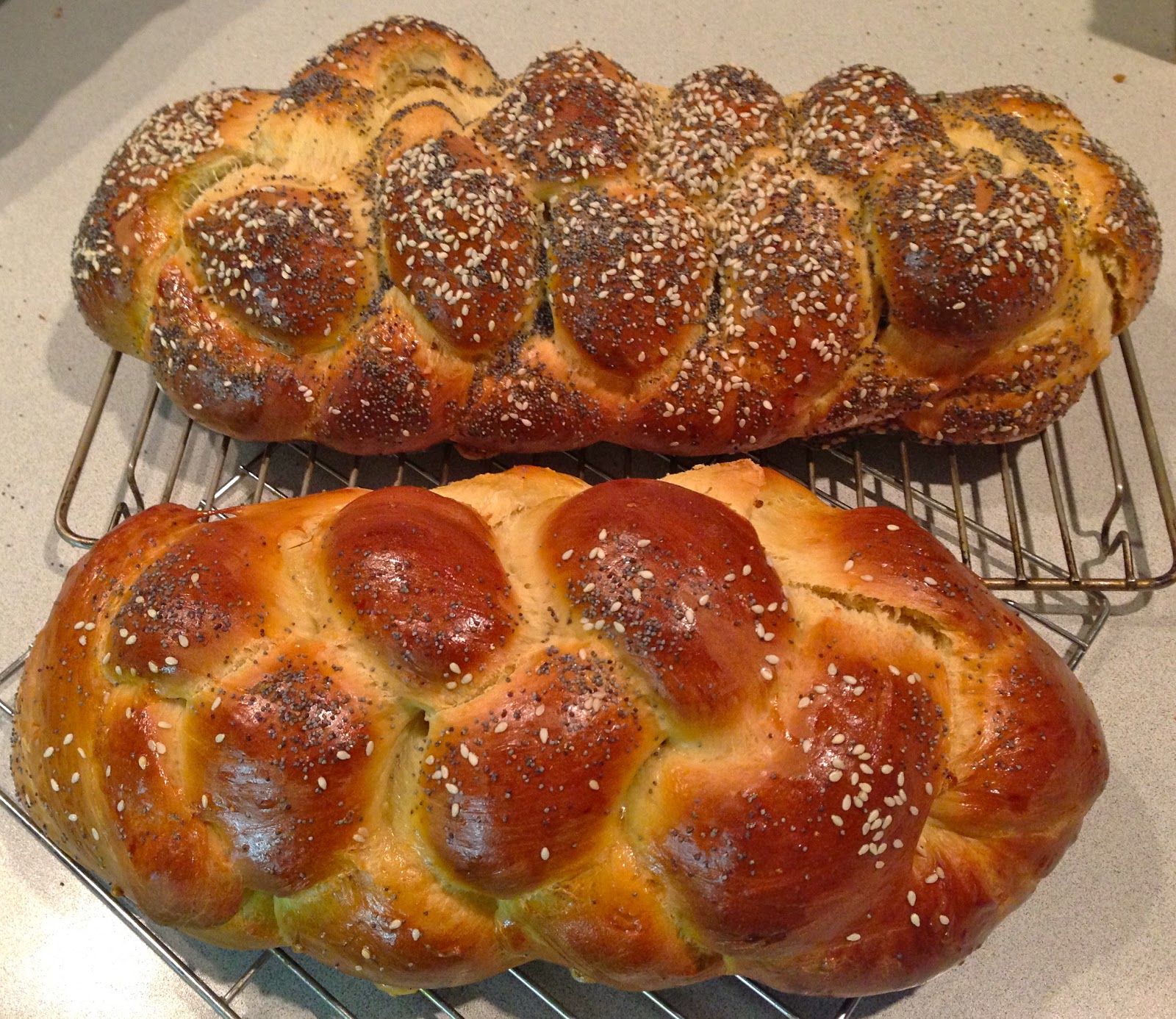
Back to my reflections of these past days.... One activity that contributed both to the joy as well as my delinquency was making challah with Shira on Friday. Side by side we braided two loaves that each turned out uniquely beautiful and were blessed and consumed with gusto by all. As planned we also invited the kids to participate in our beauty and order campaign in the garage. We gave them the opportunity (requirement) to do as I had done on my birthday—to sift through their stored belongings in the garage, to dispose of those things that no longer were important to them, to take with them or ship to their respective homes what they wanted to have there, and finally to leave us with far fewer things stored on our premises for the time being.


Before dinner we conducted what may become one of our most memorable and important "family meetings." It had been many years since we had convened one of these. It used to be a somewhat regular event back in the day, replete with agenda, minutes, story reading, and refreshments. This was our first as a family of seven. The topic was the estate planning that Debbie and I developed last summer with an emphasis less on the legal aspects of it and more about some of our softer, unbinding requests concerning how we would like to be cared for at a time when we may not be able to explicitly voice these concerns. Jacob, who would have certain defined responsibilities after Debbie and I die was wise to voice what he saw as an important reason for this conversation—the need to create transparency, allowing all to know the terms and conditions well ahead of the need to engage them.

This was followed by a Shabbat dinner that looked much like the Thanksgiving we didn't have together in November, including turkey and most, if not all, of the traditional accompaniments. Pumpkin and pecan pie were replaced with a birthday cake inscribed “Happy 65+35=100!”

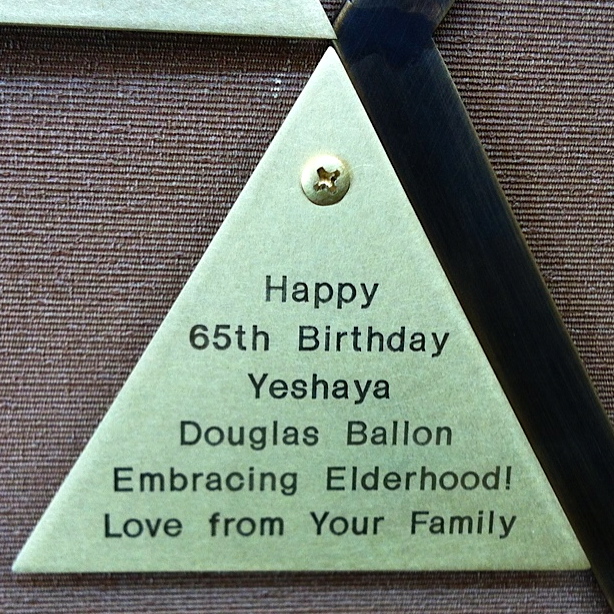
Saturday was huge. After Jake and I received the blessings from the rabbi I delivered some remarks at the rabbi’s invitation (viz., http://yesh-indeed.blogspot.com/2012/12/there-is.html). There was far more I could have said than I chose to say. I kept it well under five hundred words, and focused on appreciating the present moment, concluding with the Shehechiyanu prayer. A particularly sweet moment came later. With the recent renovation of the synagogue lobby one wall is now adorned with an array of different colored metal triangles each awaiting an inscription to mark a special event in the lives of congregants. The very first triangle to receive such words is pictured below

This was a sweet surprise that the family revealed to me during the Kiddush lunch after the morning service.
 
Later we spent most of the remainder of the afternoon preparing for our Chanukah party. The party itself was loud and fun. Jacob and Alana led us in havdalah, we lit candles, ate like horses, laughed over a gift exchange and talked into the night. Which brings me to this moment. The sun has risen. I hear the voices of others as the house awakens, and I much rather be with them than sit here tapping these keys. TTYL.

There Is!

The rabbi invited me to receive a blessing at the Shabbat service near my sixty-fifth birthday, and to make a few remarks about what it meant to me. It was also the same Shabbat, Vayeshev, upon which I celebrated my bar mitzvah in 1960 and upon which Jacob celebrated his bar mitzvah in 1990. Between the two of us we are now 100 years old! Consequently Jacob joined me on the bimah to recite the blessings over the Torah and to receive blessings from the rabbi. My remarks are below.


Congregation Beth Jacob
Redwood City, California
December 8, 2012
Shabbat Vayeshev

Some of you were here five years ago on the occasion of my sixtieth birthday when I first asked you to call me by my Hebrew name, Yeshaya. A short time after that, at the suggestion of the young lady who is now my daughter-in-law, I adopted the nickname Yesh, for short. The decision to be called Yeshaya or Yesh in many ways came out of having an adult bar mitzvah earlier that year that launched me on a new leg of my spiritual journey.


Right now I am taking courses in chanting, Talmud, spiritual aging, and Biblical Hebrew. This week in Hebrew class, as we reviewed our new vocabulary words, on the list was the word yesh! Yeshaya, my full name, is Hebrew for Isaiah—which means God is my Salvation. Yesh is a very different word in Hebrew. It is the simple declaration—there is!


What I found fascinating in class was when our teacher told us that unlike most other verbs, “Yesh is always in the present tense.” I thought about that and felt what a challenge it is to live up to my name—for me to always be in the present tense.


At milestone birthdays, such as sixty-five, it would be easy to look back with regret or condemnation at some of the things I have done or not done, or at the terrible things that I may feel have happened to me. It is also tempting to become fearful or anxious about what lies ahead that might be painful or disappointing. The challenge is to always be present. In this specific moment I have only to appreciate that I am healthy, living in peace, standing among an extraordinary community in a magnificent synagogue, and most of all blessed with a loving family—this is true abundance for which I am very grateful.


This is what we call a Shehecheyanu moment. Approaching this birthday I looked at the Shehecheyanu prayer and wondered about the fact that it’s only recited with first person plural words—thanking God for giving us life, for sustaining us, and for enabling us to reach this moment. I couldn’t find an explanation of this. While a person may speak the Shehecheyanu alone, the fact that it’s written as a plural brings awareness that when it comes to our birth and our sustenance, none of us can do it alone, nor I suspect would want to. So it’s with full appreciation of all of you that I ask you to join me in this prayer.


Baruch atta Adonai Eloheinu melekh ha'olam she-hecheyanu ve'qi'eh'manu va'higiy'anu laz'man hazeh.